Hillary Clinton
| Hillary Clinton | |
|---|---|
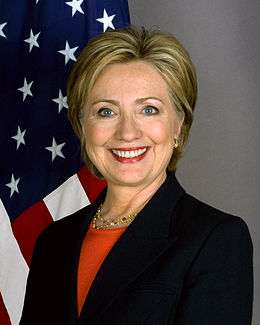 | |
| 67th United States Secretary of State | |
|
In office January 21, 2009 – February 1, 2013 | |
| President | Barack Obama |
| Deputy |
Jim Steinberg Bill Burns |
| Preceded by | Condoleezza Rice |
| Succeeded by | John Kerry |
| United States Senator from New York | |
|
In office January 3, 2001 – January 21, 2009 | |
| Preceded by | Pat Moynihan |
| Succeeded by | Kirsten Gillibrand |
| First Lady of the United States | |
|
In role January 20, 1993 – January 20, 2001 | |
| President | Bill Clinton |
| Preceded by | Barbara Bush |
| Succeeded by | Laura Bush |
| First Lady of Arkansas | |
|
In role January 11, 1983 – December 12, 1992 | |
| Governor | Bill Clinton |
| Preceded by | Gay Daniels White |
| Succeeded by | Betty Tucker |
|
In role January 9, 1979 – January 19, 1981 | |
| Governor | Bill Clinton |
| Preceded by | Barbara Pryor |
| Succeeded by | Gay Daniels White |
| Personal details | |
| Born |
Hillary Diane Rodham October 26, 1947 Chicago, Illinois, U.S. |
| Political party | Democratic (Since 1968) |
| Other political affiliations | Republican (Before 1968) |
| Spouse(s) | Bill Clinton (m. 1975) |
| Children | Chelsea |
| Education |
Wellesley College Yale University |
| Signature |
 |
| Website | Official website |
| ||
|---|---|---|
|
U.S. Secretary of State U.S. Senator from New York First Lady of the United States  |
||

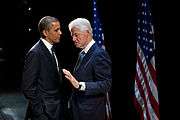

Hillary Diane Rodham Clinton (/ˈhɪləri daɪˈæn ˈrɒdəm ˈklɪntən/; born October 26, 1947) is an American politician who was the 67th United States Secretary of State from 2009 to 2013, U.S. Senator from New York from 2001 to 2009, and First Lady of the United States from 1993 to 2001. She was the Democratic Party's nominee for President of the United States in the 2016 election.
Born in Chicago and raised in the suburban town of Park Ridge, Illinois, Clinton attended Wellesley College, graduating in 1969, and earned a J.D. from Yale Law School in 1973. After serving as a congressional legal counsel, she moved to Arkansas and married Bill Clinton in 1975. In 1977, she co-founded Arkansas Advocates for Children and Families. She was appointed the first female chair of the Legal Services Corporation in 1978 and became the first woman partner at Rose Law Firm the following year. As First Lady of Arkansas, she led a task force whose recommendations helped reform Arkansas's public schools, and served on several corporate boards.
As First Lady of the United States, Clinton led the unsuccessful effort to enact the Clinton health care plan of 1993. In 1997 and 1999, she helped create the State Children's Health Insurance Program. She also tackled the problems of adoption and family safety and foster care. At the 1995 UN conference on women (held in Beijing), Clinton stated in a then controversial and influential speech, that "human rights are women's rights and women's rights are human rights". Her marriage survived the Lewinsky scandal of 1998, and her role as first lady drew a polarized response from the public. Clinton was elected in 2000 as the first female senator from New York, the only first lady ever to seek elective office. Following the September 11 terrorist attacks, she voted to approve the war in Afghanistan and for the Iraq Resolution. She took a leading role in investigating the health issues faced by 9/11 first responders. She further voted against the Bush tax cuts, and against drilling in the Arctic National Wildlife Refuge. She was re-elected to the Senate in 2006. Running for president in 2008, she won far more delegates than any previous female candidate, but lost the Democratic nomination to Barack Obama despite receiving more votes.[1]
As Secretary of State in the Obama Administration from 2009 to 2013, Clinton responded to the Arab Spring, during which she advocated the U.S. military intervention in Libya. She helped organize a diplomatic isolation and international sanctions regime against Iran, in an effort to force curtailment of that country's nuclear program; this would eventually lead to the multinational Joint Comprehensive Plan of Action agreement in 2015. Leaving office after Obama's first term, she wrote her fifth book and undertook speaking engagements.
Clinton made a second presidential run in 2016. She received the most votes and primary delegates in the 2016 Democratic primaries, and formally accepted her party's nomination for President of the United States on July 28, 2016, with vice presidential running mate Senator Tim Kaine. She became the first female candidate to be nominated for president by a major U.S. political party. As part of her 2016 platform, she emphasized raising incomes, improvements to the Affordable Care Act and reform of campaign finance and Wall Street. She favored allowing pathways to citizenship for undocumented immigrants, combating climate change, expanding and protecting LGBT and women's rights, and instituting family support through paid parental leave and universal preschool. However, a controversy relating to a privately hosted email server during her tenure as Secretary of State became a significant issue, including in the closing days of the campaign. On November 8, 2016, Clinton lost to Republican rival Donald Trump, failing to obtain the necessary 270 votes in the electoral college, despite receiving a plurality of the national popular vote. It was the fourth US presidential election where the losing candidate won the popular vote.
Early life and education
Early life
Hillary[lower-alpha 1] Diane Rodham was born on October 26, 1947, at Edgewater Hospital in Chicago, Illinois.[3][4] She was raised in a United Methodist family, living first in Chicago; when she was three, her family moved to Park Ridge, Illinois.[5] Her father, Hugh Ellsworth Rodham (1911–1993), was of Welsh and English descent;[6] he managed a successful small business in the textile industry.[7] Her mother, Dorothy Emma Howell (1919–2011), was a homemaker of English, Scottish, French Canadian (Quebec), Welsh and Dutch descent.[6][8][9] Hillary has two younger brothers, Hugh and Tony.[10]

As a child, Rodham was a favorite of her teachers at the public schools that she attended in Park Ridge.[11] She participated in sports such as swimming and baseball and earned numerous badges as a Brownie and a Girl Scout.[11] She has often told a story[12][13][14] of being inspired by U.S. efforts during the Space Race and sending a letter to NASA around 1961 asking what she could do to become an astronaut, only to be told that no women were being accepted into the program.[15]
She attended Maine East High School, where she participated in the student council, the school newspaper, and was selected for the National Honor Society.[3][16] She won election as class vice president for her junior year, but then lost an election for class president for her senior year against two boys, one of whom told her, "you are really stupid if you think a girl can be elected president."[17] For her senior year, she and other students were transferred to the then new Maine South High School, where she was a National Merit Finalist and was voted "most likely to succeed". She graduated in the top five percent of her class of 1965.[18] Rodham's mother wanted her to have an independent, professional career,[9] and her father, otherwise a traditionalist, felt that his daughter's abilities and opportunities should not be limited by gender.[19]
Raised in a politically conservative household,[9] Rodham helped canvass Chicago's South Side at age 13 following the very close 1960 U.S. presidential election, where she saw evidence of electoral fraud (such as voting list entries showing addresses that were empty lots) against Republican candidate Richard Nixon.[20] She then volunteered to campaign for Republican candidate Barry Goldwater in the U.S. presidential election of 1964.[21] Rodham's early political development was shaped most by her high school history teacher (like her father, a fervent anti-communist), who introduced her to Goldwater's The Conscience of a Conservative, and by her Methodist youth minister (like her mother, concerned with issues of social justice), with whom she saw, and afterwards briefly met, civil rights leader Martin Luther King Jr. at a 1962 speech in Chicago's Orchestra Hall.[22]
Wellesley College years
In 1965, Rodham enrolled at Wellesley College, where she majored in political science.[23][24] During her freshman year, she served as president of the Wellesley Young Republicans;[25][26] with this Rockefeller Republican-oriented group,[27] she supported the elections of John Lindsay to Mayor of New York City and Massachusetts Attorney General Edward Brooke to the United States Senate.[28] She later stepped down from this position. Clinton would later write in 2003 that her views at this time changed regarding the American Civil Rights Movement and the Vietnam War.[25] In a letter to her youth minister at this time, she described herself as "a mind conservative and a heart liberal".[29] In contrast to the 1960s current that advocated radical actions against the political system, she sought to work for change within it.[30][31]
In her junior year, Rodham became a supporter of the antiwar presidential nomination campaign of Democrat Eugene McCarthy.[32] In early 1968, she was elected president of the Wellesley College Government Association and served through early 1969.[30][33] Following the assassination of Martin Luther King Jr., Rodham organized a two-day student strike and worked with Wellesley's black students to recruit more black students and faculty.[32] In her student government role, she played a role in keeping Wellesley from being embroiled in the student disruptions common to other colleges.[30][34] A number of her fellow students thought she might some day become the first female President of the United States.[30]
To help her better understand her changing political views, Professor Alan Schechter assigned Rodham to intern at the House Republican Conference, and she attended the "Wellesley in Washington" summer program.[32] Rodham was invited by moderate New York Republican Representative Charles Goodell to help Governor Nelson Rockefeller's late-entry campaign for the Republican nomination.[32] Rodham attended the 1968 Republican National Convention in Miami. However, she was upset by the way Richard Nixon's campaign portrayed Rockefeller and by what she perceived as the convention's "veiled" racist messages, and left the Republican Party for good.[32] Rodham wrote her senior thesis, a critique of the tactics of radical community organizer Saul Alinsky, under Professor Schechter.[35] (Years later, while she was first lady, access to her thesis was restricted at the request of the White House and it became the subject of some speculation. The thesis was later released.[35])
In 1969, she graduated with a Bachelor of Arts,[36] with departmental honors in political science.[35] After some fellow seniors requested that the college administration allow a student speaker at commencement, she became the first student in Wellesley College history to speak at the event, following commencement speaker Senator Brooke.[33][37] Her speech received a standing ovation lasting seven minutes.[30][38][39] She was featured in an article published in Life magazine,[40][41] due to the response to a part of her speech that criticized Senator Brooke.[37] She also appeared on Irv Kupcinet's nationally syndicated television talk show as well as in Illinois and New England newspapers.[42] That summer, she worked her way across Alaska, washing dishes in Mount McKinley National Park and sliming salmon in a fish processing cannery in Valdez (which fired her and shut down overnight when she complained about unhealthful conditions).[43]

Yale Law School and postgraduate studies
Rodham then entered Yale Law School, where she served on the editorial board of the Yale Review of Law and Social Action.[44] During her second year, she worked at the Yale Child Study Center,[45] learning about new research on early childhood brain development and working as a research assistant on the seminal work, Beyond the Best Interests of the Child (1973).[46][47] She also took on cases of child abuse at Yale–New Haven Hospital[46] and volunteered at New Haven Legal Services to provide free legal advice for the poor.[45] In the summer of 1970 she was awarded a grant to work at Marian Wright Edelman's Washington Research Project, where she was assigned to Senator Walter Mondale's Subcommittee on Migratory Labor. There she researched migrant workers' problems in housing, sanitation, health and education.[48] Edelman later became a significant mentor.[49] Rodham was recruited by political advisor Anne Wexler to work on the 1970 campaign of Connecticut U.S. Senate candidate Joseph Duffey, with Rodham later crediting Wexler with providing her first job in politics.[50]
In the late spring of 1971, she began dating Bill Clinton, also a law student at Yale. During the summer, she interned at the Oakland, California, law firm of Treuhaft, Walker and Burnstein.[51] The firm was well known for its support of constitutional rights, civil liberties, and radical causes (two of its four partners were current or former Communist Party members);[51] Rodham worked on child custody and other cases.[lower-alpha 2] Clinton canceled his original summer plans in order to live with her in California;[55] the couple continued living together in New Haven when they returned to law school.[52] The following summer, Rodham and Clinton campaigned in Texas for unsuccessful 1972 Democratic presidential candidate George McGovern.[56] She received a Juris Doctor degree from Yale in 1973,[36] having stayed on an extra year to be with Clinton.[57] He first proposed marriage to her following graduation but she declined, uncertain if she wanted to tie her future to his.[57]
Rodham began a year of postgraduate study on children and medicine at the Yale Child Study Center.[58] Her first scholarly article, "Children Under the Law", was published in the Harvard Educational Review in late 1973.[59] Discussing the new children's rights movement, it stated that "child citizens" were "powerless individuals"[60] and argued that children should not be considered equally incompetent from birth to attaining legal age, but instead that courts should presume competence except when there is evidence otherwise, on a case-by-case basis.[61] The article became frequently cited in the field.[62]
Marriage, family, law career, and First Lady of Arkansas
From the East Coast to Arkansas
During her postgraduate study, Rodham served as staff attorney for Edelman's newly founded Children's Defense Fund in Cambridge, Massachusetts,[63] and as a consultant to the Carnegie Council on Children.[64] In 1974 she was a member of the impeachment inquiry staff in Washington, D.C., advising the House Committee on the Judiciary during the Watergate scandal.[65] Under the guidance of Chief Counsel John Doar and senior member Bernard W. Nussbaum,[46] Rodham helped research procedures of impeachment and the historical grounds and standards for impeachment.[65] The committee's work culminated in the resignation of President Richard Nixon in August 1974.[65]
By then, Rodham was viewed as someone with a bright political future. Democratic political organizer and consultant Betsey Wright had moved from Texas to Washington the previous year to help guide Rodham's career.[66] Wright thought she had the potential to become a future senator or president.[67] Meanwhile, boyfriend Bill Clinton had repeatedly asked Rodham to marry him and she continued to demur.[68] After failing the District of Columbia bar exam[69] and passing the Arkansas exam, Rodham came to a key decision. As she later wrote, "I chose to follow my heart instead of my head".[70] She thus followed Clinton to Arkansas, rather than staying in Washington, where career prospects were brighter. He was then teaching law and running for a seat in the U.S. House of Representatives in his home state. In August 1974, Rodham moved to Fayetteville, Arkansas, and became one of only two female faculty members in the School of Law at the University of Arkansas, Fayetteville.[71][72]
Early Arkansas years
At the university, Rodham gave classes in criminal law, where she was considered a rigorous teacher and tough grader.[73] She became the first director of a new legal aid clinic at the school, securing support from the local bar association and gaining federal funding.[74] Among her cases was one where she was obliged by request of the court to serve as defense counsel to a man accused of raping a 12-year-old girl; she put on an effective defense that led to his pleading guilty to a much lesser charge.[75] Decades later, the victim said that the defense counsel had put her "through hell" during the legal process; Hillary Clinton has called the trial a "terrible case".[75] During her time in Fayetteville, Rodham and several other women founded the city's first rape crisis center.[74] Rodham still harbored doubts about marriage, concerned that her separate identity would be lost and her accomplishments viewed in the light of someone else's.[76]
Rodham and Bill Clinton bought a house in Fayetteville in the summer of 1975, and she finally agreed to marry him.[77] Their wedding took place on October 11, 1975, in a Methodist ceremony in their living room.[78] A story about the marriage in the Arkansas Gazette indicated that she was retaining the name Hillary Rodham.[79][80] The motivation was to keep the couple's professional lives separate and avoid apparent conflicts of interest and because, as she told a friend at the time, "it showed that I was still me."[81] The decision did upset both their mothers.[82] Clinton had lost the congressional race in 1974, but in November 1976 was elected Arkansas Attorney General, and so the couple moved to the state capital of Little Rock.[83] There, in February 1977, Rodham joined the venerable Rose Law Firm, a bastion of Arkansan political and economic influence.[84] She specialized in patent infringement and intellectual property law[44] while also working pro bono in child advocacy;[85] she rarely performed litigation work in court.[86]
Rodham maintained her interest in children's law and family policy, publishing the scholarly articles "Children's Policies: Abandonment and Neglect" in 1977[87] and "Children's Rights: A Legal Perspective" in 1979.[88] The latter continued her argument that children's legal competence depended upon their age and other circumstances and that in serious medical rights cases, judicial intervention was sometimes warranted.[61] An American Bar Association chair later said, "Her articles were important, not because they were radically new but because they helped formulate something that had been inchoate."[61] Historian Garry Wills would later describe her as "one of the more important scholar-activists of the last two decades",[89] while conservatives said her theories would usurp traditional parental authority,[90] would allow children to file frivolous lawsuits against their parents,[61] and exemplified legal "crit" theory run amok.[91]

In 1977, Rodham cofounded Arkansas Advocates for Children and Families, a state-level alliance with the Children's Defense Fund.[44][93] Later that year, President Jimmy Carter (for whom Rodham had been the 1976 campaign director of field operations in Indiana)[94] appointed her to the board of directors of the Legal Services Corporation,[95] and she served in that capacity from 1978 until the end of 1981.[96] From mid-1978 to mid-1980,[lower-alpha 3] she was the chair of that board, the first woman to have the job.[97] During her time as chair, funding for the Corporation was expanded from $90 million to $300 million; subsequently she successfully fought President Ronald Reagan's attempts to reduce the funding and change the nature of the organization.[85]
Following her husband's November 1978 election as Governor of Arkansas, Rodham became First Lady of Arkansas in January 1979, a title that she held for twelve years (1979–81, 1983–92). Clinton appointed her chair of the Rural Health Advisory Committee the same year,[98] where she secured federal funds to expand medical facilities in Arkansas's poorest areas without affecting doctors' fees.[99]
In 1979, Rodham became the first woman to be made a full partner of Rose Law Firm.[100] From 1978 until they entered the White House, she had a higher salary than her husband.[101] During 1978 and 1979, while looking to supplement their income, Rodham engaged in the trading of cattle futures contracts;[102] an initial $1,000 investment generated nearly $100,000 when she stopped trading after ten months.[103] The couple also began their ill-fated investment in the Whitewater Development Corporation real estate venture with Jim and Susan McDougal at this time.[102] Both of these became subjects of controversy in the 1990s.
On February 27, 1980, Rodham gave birth to a daughter, Chelsea. In November 1980, Bill Clinton was defeated in his bid for re-election.[104]
Later Arkansas years
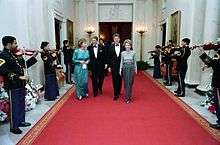
Bill Clinton returned to the governor's office two years later after winning the election of 1982. During her husband's campaign, Hillary began to use the name "Hillary Clinton", or sometimes "Mrs. Bill Clinton", to assuage the concerns of Arkansas voters; she also took a leave of absence from Rose Law to campaign for him full-time.[105] As First Lady of Arkansas again, she made a point of using Hillary Rodham Clinton as her name.[lower-alpha 4] She was named chair of the Arkansas Education Standards Committee in 1983, where she sought to reform the state's court-sanctioned public education system.[111][112] In one of the Clinton governorship's most important initiatives, she fought a prolonged but ultimately successful battle against the Arkansas Education Association to establish mandatory teacher testing and state standards for curriculum and classroom size.[98][111] It became her introduction into the politics of a highly visible public policy effort.[80][111] In 1985, she introduced Arkansas's Home Instruction Program for Preschool Youth, a program that helps parents work with their children in preschool preparedness and literacy.[113] She was named Arkansas Woman of the Year in 1983 and Arkansas Mother of the Year in 1984.[114][115]
Clinton continued to practice law with the Rose Law Firm while she was First Lady of Arkansas. She earned less than the other partners, as she billed fewer hours,[116] but still made more than $200,000 in her final year there.[117] The firm considered her a "rainmaker" because she brought in clients, partly thanks to the prestige she lent it and to her corporate board connections.[117] She was also very influential in the appointment of state judges.[117] Bill Clinton's Republican opponent in his 1986 gubernatorial re-election campaign accused the Clintons of conflict of interest, because Rose Law did state business; the Clintons countered the charge by saying that state fees were walled off by the firm before her profits were calculated.[118]
From 1982 to 1988, Clinton was on the board of directors, sometimes as chair, of the New World Foundation,[119] which funded a variety of New Left interest groups.[120] From 1987 to 1991, she was the first chair of the American Bar Association's Commission on Women in the Profession, created to address gender bias in the legal profession and induce the association to adopt measures to combat it.[121] She was twice named by The National Law Journal as one of the 100 most influential lawyers in America: in 1988 and in 1991.[122] When Bill Clinton thought about not running again for governor in 1990, Hillary Clinton considered running, but private polls were unfavorable and, in the end, he ran and was re-elected for the final time.[123]

Clinton served on the boards of the Arkansas Children's Hospital Legal Services (1988–92)[124] and the Children's Defense Fund (as chair, 1986–92).[3][125] In addition to her positions with nonprofit organizations, she also held positions on the corporate board of directors of TCBY (1985–92),[126] Wal-Mart Stores (1986–92)[127] and Lafarge (1990–92).[128] TCBY and Wal-Mart were Arkansas-based companies that were also clients of Rose Law.[117][129] Clinton was the first female member on Wal-Mart's board, added following pressure on chairman Sam Walton to name a woman to it.[129] Once there, she pushed successfully for Wal-Mart to adopt more environmentally friendly practices, was largely unsuccessful in a campaign for more women to be added to the company's management, and was silent about the company's famously anti-labor union practices.[127][129][130]
Bill Clinton presidential campaign of 1992
Clinton received sustained national attention for the first time when her husband became a candidate for the 1992 Democratic presidential nomination. Before the New Hampshire primary, tabloid publications printed assertions that Bill Clinton had engaged in an extramarital affair with Gennifer Flowers.[131] In response, the Clintons appeared together on 60 Minutes, where Bill denied the affair, but acknowledged "causing pain in my marriage".[132] This joint appearance was credited with rescuing his campaign.[133] During the campaign, Hillary made culturally disparaging remarks about Tammy Wynette's outlook on marriage as described in her classic song "Stand by Your Man",[lower-alpha 5] and later in the campaign about how she could have chosen to be like women staying home and baking cookies and having teas, but wanted to pursue her career instead.[lower-alpha 6] The remarks were widely criticized, particularly by those who were, or defended, stay-at-home mothers, and in retrospect, were ill-considered by her own admission. Bill said that in electing him, the nation would "get two for the price of one", referring to the prominent role his wife would assume.[139] Beginning with Daniel Wattenberg's August 1992 The American Spectator article "The Lady Macbeth of Little Rock", Hillary's own past ideological and ethical record came under attack from conservatives.[90] At least twenty other articles in major publications also drew comparisons between her and Lady Macbeth.[140]
First Lady of the United States
Role as first lady
When Bill Clinton took office as President in January 1993, Hillary Rodham Clinton became the First Lady, and her press secretary reiterated that she would be using that form of her name.[lower-alpha 4] She was the first inaugural First Lady to have earned a postgraduate degree and to have her own professional career up to the time of entering the White House.[141] She was also the first to have an office in the West Wing of the White House in addition to the usual first lady offices in the East Wing.[58][142] She was part of the innermost circle vetting appointments to the new administration and her choices filled at least eleven top-level positions and dozens more lower-level ones.[143] After Eleanor Roosevelt, Clinton was regarded as the most openly empowered presidential wife in American history.[144][145]
Some critics called it inappropriate for the first lady to play a central role in matters of public policy. Supporters pointed out that Clinton's role in policy was no different from that of other White House advisors and that voters had been well aware that she would play an active role in her husband's presidency.[146] Bill Clinton's campaign promise of "two for the price of one" led opponents to refer derisively to the Clintons as "co-presidents" or sometimes use the Arkansas label "Billary".[98][147][148] The pressures of conflicting ideas about the role of a first lady were enough to send Hillary Clinton into "imaginary discussions" with the also-politically-active Eleanor Roosevelt.[lower-alpha 7] From the time she came to Washington, Hillary also found refuge in a prayer group of the Fellowship that featured many wives of conservative Washington figures.[152][153] Triggered in part by the death of her father in April 1993, she publicly sought to find a synthesis of Methodist teachings, liberal religious political philosophy, and Tikkun editor Michael Lerner's "politics of meaning" to overcome what she saw as America's "sleeping sickness of the soul"; that would lead to a willingness "to remold society by redefining what it means to be a human being in the twentieth century, moving into a new millennium."[154][155]
Health care and other policy initiatives
In January 1993, President Clinton named Hillary to chair a Task Force on National Health Care Reform, hoping to replicate the success she had in leading the effort for Arkansas education reform.[156] Unconvinced regarding the merits of the North American Free Trade Agreement (NAFTA), she privately urged that passage of health care reform be given higher priority.[157][158] The recommendation of the task force became known as the Clinton health care plan, a comprehensive proposal that would require employers to provide health coverage to their employees through individual health maintenance organizations. Its opponents quickly derided the plan as "Hillarycare", and it faced opposition from even some Democrats in Congress.[159] Some protesters against the proposed plan became vitriolic, and during a July 1994 bus tour to rally support for the plan, Clinton wore a bulletproof vest at times.[159]
.jpg)
Failing to gather enough support for a floor vote in either the House or the Senate (although Democrats controlled both chambers), the proposal was abandoned in September 1994.[160] Clinton later acknowledged in her memoir that her political inexperience partly contributed to the defeat, but cited many other factors. The First Lady's approval ratings, which had generally been in the high-50s percent range during her first year, fell to 44 percent in April 1994 and 35 percent by September 1994.[161]
Republicans made the Clinton health care plan a major campaign issue of the 1994 midterm elections.[162] Republicans saw a net gain of fifty-three seats in the House election and seven in the Senate election, winning control of both; many analysts and pollsters found the plan to be a major factor in the Democrats' defeat, especially among independent voters.[163] The White House subsequently sought to downplay Clinton's role in shaping policy.[164] Opponents of universal health care would continue to use "Hillarycare" as a pejorative label for similar plans by others.[165]

Along with Senators Ted Kennedy and Orrin Hatch, Clinton was a force behind the passage of the State Children's Health Insurance Program in 1997, a federal effort that provided state support for children whose parents could not provide them with health coverage, and conducted outreach efforts on behalf of enrolling children in the program once it became law.[166] She promoted nationwide immunization against childhood illnesses and encouraged older women to seek a mammogram to detect breast cancer, with coverage provided by Medicare.[167] She successfully sought to increase research funding for prostate cancer and childhood asthma at the National Institutes of Health.[58] The First Lady worked to investigate reports of an illness that affected veterans of the Gulf War, which became known as the Gulf War syndrome.[58]
Enactment of welfare reform was a major goal of Bill Clinton's presidency, but when the first two bills on the issue came from a Republican-controlled Congress that lacked protections for people coming off welfare, Hillary urged him to veto the bills, which he did.[168][169] A third version came up during his 1996 general election campaign that restored some of the protections but cut the scope of benefits in other areas; critics, including her past mentor Edelman, urged her to get the president to veto it again.[168] But she decided to support the bill, which became the Welfare Reform Act of 1996, as the best political compromise available.[168][169] This caused a rift with Edelman that Hillary later called "sad and painful".[169]
Together with Attorney General Janet Reno, Clinton helped create the Office on Violence Against Women at the Department of Justice.[58] In 1997, she initiated and shepherded the Adoption and Safe Families Act, which she regarded as her greatest accomplishment as first lady.[58][170] In 1999, she was instrumental in the passage of the Foster Care Independence Act, which doubled federal monies for teenagers aging out of foster care.[170] As first lady, Clinton hosted numerous White House conferences, including ones on Child Care (1997),[171] on Early Childhood Development and Learning (1997),[172] and on Children and Adolescents (2000).[173] She also hosted the first-ever White House Conference on Teenagers (2000)[174] and the first-ever White House Conference on Philanthropy (1999).[175]
Clinton traveled to 79 countries during this time,[176] breaking the mark for most-traveled first lady held by Pat Nixon.[177] She did not hold a security clearance or attend National Security Council meetings, but played a role in U.S. diplomacy attaining its objectives.[178] A March 1995 five-nation trip to South Asia, on behest of the U.S. State Department and without her husband, sought to improve relations with India and Pakistan.[179] Clinton was troubled by the plight of women she encountered, but found a warm response from the people of the countries she visited and gained a better relationship with the American press corps.[180] The trip was a transformative experience for her and presaged her eventual career in diplomacy.[181]

In a September 1995 speech before the Fourth World Conference on Women in Beijing, Clinton argued very forcefully against practices that abused women around the world and in the People's Republic of China itself,[182] declaring that "it is no longer acceptable to discuss women's rights as separate from human rights".[182] Delegates from over 180 countries heard her say: "If there is one message that echoes forth from this conference, let it be that human rights are women's rights and women's rights are human rights, once and for all."[183] In doing so, she resisted both internal administration and Chinese pressure to soften her remarks.[176][183] The speech became a key moment in the empowerment of women and years later women around the world would recite Clinton's key phrases.[184] She was one of the most prominent international figures during the late 1990s to speak out against the treatment of Afghan women by the Taliban.[185][186] She helped create Vital Voices, an international initiative sponsored by the U.S. to promote the participation of women in the political processes of their countries.[187] It and Clinton's own visits encouraged women to make themselves heard in the Northern Ireland peace process.[188]
Whitewater and other investigations
First Lady Clinton was a subject of several investigations by the United States Office of the Independent Counsel, committees of the U.S. Congress, and the press.
The Whitewater controversy was the focus of media attention from the publication of a New York Times report during the 1992 presidential campaign[189] and throughout her time as first lady. The Clintons had lost their late-1970s investment in the Whitewater Development Corporation; at the same time, their partners in that investment, Jim and Susan McDougal, operated Madison Guaranty, a savings and loan institution that retained the legal services of Rose Law Firm[190] and may have been improperly subsidizing Whitewater losses.[189] Madison Guaranty later failed, and Clinton's work at Rose was scrutinized for a possible conflict of interest in representing the bank before state regulators that her husband had appointed.[189] She said she had done minimal work for the bank.[191] Independent counsels Robert Fiske and Kenneth Starr subpoenaed Clinton's legal billing records; she said she did not know where they were.[192][193] The records were found in the First Lady's White House book room after a two-year search and delivered to investigators in early 1996.[193] The delayed appearance of the records sparked intense interest and another investigation concerning how they surfaced and where they had been.[193] Clinton's staff attributed the problem to continual changes in White House storage areas since the move from the Arkansas Governor's Mansion.[194] On January 26, 1996, Clinton became the first first lady to be subpoenaed to testify before a federal grand jury.[192] After several Independent Counsels had investigated, a final report was issued in 2000 that stated there was insufficient evidence that either Clinton had engaged in criminal wrongdoing.[195]

Scrutiny of the May 1993 firings of the White House Travel Office employees, an affair that became known as "Travelgate", began with charges that the White House had used audited financial irregularities in the Travel Office operation as an excuse to replace the staff with friends from Arkansas.[196] The 1996 discovery of a two-year-old White House memo caused the investigation to focus on whether Clinton had orchestrated the firings and whether the statements she made to investigators about her role in the firings were true.[197][198] The 2000 final Independent Counsel report concluded she was involved in the firings and that she had made "factually false" statements, but that there was insufficient evidence that she knew the statements were false, or knew that her actions would lead to firings, to prosecute her.[199]
Following deputy White House counsel Vince Foster's July 1993 suicide, allegations were made that Clinton had ordered the removal of potentially damaging files (related to Whitewater or other matters) from Foster's office on the night of his death.[200] Independent Counsel Kenneth Starr investigated this, and, by 1999, Starr was reported to be holding the investigation open, despite his staff having told him there was no case to be made.[201] When Starr's successor Robert Ray issued his final Whitewater reports in 2000, no claims were made against Clinton regarding this.[195] An outgrowth of the "Travelgate" investigation was the June 1996 discovery of improper White House access to hundreds of FBI background reports on former Republican White House employees, an affair that some called "Filegate".[202] Accusations were made that Clinton had requested these files and that she had recommended hiring an unqualified individual to head the White House Security Office.[203] The 2000 final Independent Counsel report found no substantial or credible evidence that Clinton had any role or showed any misconduct in the matter.[202]
In March 1994, newspaper reports revealed her spectacular profits from trading in 1978–79, thus leading to the cattle futures controversy.[204] Allegations were made in the press of conflict of interest and disguised bribery, and several individuals analyzed her trading records, but no formal investigation was made and she was never charged with any wrongdoing.[205]
There was a controversy that arose in early 2001 over gifts made to the White House, rather than to the Clintons personally, that were removed and shipped to the Clintons' private residence during the last year of Bill Clinton's time in office.[206] Following public pressure the couple returned $134,000 worth of such gifts.[207] Hillary Clinton faced additional criticism for having possibly solicited personal gifts shortly before being sworn in as a senator, at which time she would have been barred from accepting them.[207]
Response to Lewinsky scandal
In 1998, the Clintons' relationship became the subject of much speculation when investigations revealed that the President had engaged in an extramarital affair with White House intern Monica Lewinsky.[208] Events surrounding the Lewinsky scandal eventually led to the impeachment of Bill Clinton by the House of Representatives and later acquittal by the Senate. When the allegations against her husband were first made public, Hillary Clinton stated that the allegations were part of a "vast right-wing conspiracy",[209][210] characterizing the Lewinsky charges as the latest in a long, organized, collaborative series of charges by Bill's political enemies[lower-alpha 8] rather than any wrongdoing by her husband. She later said that she had been misled by her husband's initial claims that no affair had taken place.[212] After the evidence of President Clinton's encounters with Lewinsky became incontrovertible, she issued a public statement reaffirming her commitment to their marriage, but privately was reported to be furious at him and was unsure if she wanted to stay in the marriage.[213] The White House residence staff noticed a pronounced level of tension between the couple during this period.[214]
Public reaction varied. Some women admired her strength and poise in private matters that were made public, some sympathized with her as a victim of her husband's insensitive behavior, others criticized her as being an enabler to her husband's indiscretions, while still others accused her of cynically staying in a failed marriage as a way of keeping or even fostering her own political influence.[215] Her public approval ratings in the wake of the revelations shot upward to around 70 percent, the highest they had ever been.[215] In her 2003 memoir, she would attribute her decision to stay married to "a love that has persisted for decades" and add: "No one understands me better and no one can make me laugh the way Bill does. Even after all these years, he is still the most interesting, energizing and fully alive person I have ever met."[216]
Matters surrounding the Lewinsky scandal left Bill Clinton with substantial legal bills; in 2014, Hillary would state that she and Bill had left the White House "not only dead broke, but in debt." The statement may have been literally accurate but ignored the potentially enormous earnings potential of ex-presidents giving paid speeches upon leaving office as well as the couple's ability to secure loans from banks.[217]
Traditional duties
Clinton initiated and was the founding chair of the Save America's Treasures program, a national effort that matched federal funds to private donations to preserve and restore historic items and sites,[218] including the flag that inspired "The Star-Spangled Banner" and the First Ladies Historic Site in Canton, Ohio.[58] She was head of the White House Millennium Council[219] and hosted Millennium Evenings,[220] a series of lectures that discussed futures studies, one of which became the first live simultaneous webcast from the White House.[58] Clinton also created the first White House Sculpture Garden, located in the Jacqueline Kennedy Garden, which displayed large contemporary American works of art loaned from museums.[221]
In the White House, Clinton placed donated handicrafts of contemporary American artisans, such as pottery and glassware, on rotating display in the state rooms.[58] She oversaw the restoration of the Blue Room to be historically authentic to the period of James Monroe[222] and the Map Room to how it looked during World War II.[223] Working with Arkansas interior decorator Kaki Hockersmith over an eight-year period, she oversaw extensive, privately funded redecoration efforts around the building, often trying to make it look brighter.[224] These included changing the look of the Treaty Room, a presidential study, to along 19th century lines.[223] Overall the redecoration brought mixed notices, with Victorian furnishings for the Lincoln Sitting Room being criticized the most.[224] Clinton hosted many large-scale events at the White House, such as a Saint Patrick's Day reception, a state dinner for visiting Chinese dignitaries, a contemporary music concert that raised funds for music education in public schools, a New Year's Eve celebration at the turn of the 21st century, and a state dinner honoring the bicentennial of the White House in November 2000.[58]
United States Senate
2000 U.S. Senate election
When New York's long-serving U.S. Senator Daniel Patrick Moynihan announced his retirement in November 1998, several prominent Democratic figures, including Representative Charles Rangel of New York, urged Clinton to run for Moynihan's open seat in the Senate election of 2000.[225] Once she decided to run, the Clintons purchased a home in Chappaqua, New York, north of New York City, in September 1999.[226] She became the first First Lady of the United States to be a candidate for elected office.[227] Initially, Clinton expected to face Rudy Giuliani (the mayor of New York City) as her Republican opponent in the election. Giuliani withdrew from the race in May 2000 after he was diagnosed with prostate cancer and matters related to his failing marriage became public, and Clinton instead faced Rick Lazio, a Republican member of the U.S. House of Representatives representing New York's 2nd congressional district. Throughout the campaign, opponents accused Clinton of carpetbagging, as she had never resided in New York nor participated in the state's politics before the 2000 Senate race.[228]
Clinton began her campaign, which was managed by Bill de Blasio, by visiting all 62 counties in the State, in a "listening tour" of small-group settings.[229] She devoted considerable time in traditionally Republican Upstate New York regions.[230] Clinton vowed to improve the economic situation in those areas, promising to deliver 200,000 jobs to the state over her term. Her plan included tax credits to reward job creation and encourage business investment, especially in the high-tech sector. She called for personal tax cuts for college tuition and long-term care.[230]
The contest drew national attention. Lazio blundered during a September debate by seeming to invade Clinton's personal space trying to get her to sign a fundraising agreement.[231] The campaigns of Clinton and Lazio, along with Giuliani's initial effort, spent a record combined $90 million.[232] Clinton won the election on November 7, 2000, with 55 percent of the vote to Lazio's 43 percent.[231] She was sworn in as U.S. senator on January 3, 2001,[233] making her the first (and so far only) woman to have held an elected office either while,[lower-alpha 9] or after, serving as first lady.
First term


Upon entering the Senate, Clinton maintained a low public profile and built relationships with senators from both parties.[234] She forged alliances with religiously inclined senators by becoming a regular participant in the Senate Prayer Breakfast.[152][235] She served on five Senate committees: Committee on Budget (2001–02),[236] Committee on Armed Services (2003–09),[237] Committee on Environment and Public Works (2001–09),[236] Committee on Health, Education, Labor and Pensions (2001–09)[236] and Special Committee on Aging.[238] She was also a member of the Commission on Security and Cooperation in Europe[239] (2001–09).[240]
Following the September 11 terrorist attacks, Clinton sought to obtain funding for the recovery efforts in New York City and security improvements in her state. Working with New York's senior senator, Charles Schumer, she was instrumental in securing $21 billion in funding for the World Trade Center site's redevelopment.[241] She subsequently took a leading role in investigating the health issues faced by 9/11 first responders.[242] Clinton voted for the USA Patriot Act in October 2001. In 2005, when the act was up for renewal, she expressed concerns with the USA Patriot Act Reauthorization Conference Report regarding civil liberties,[243] before voting in favor of the USA PATRIOT Improvement and Reauthorization Act of 2005 in March 2006 that gained large majority support.[244]
Clinton strongly supported the 2001 U.S. military action in Afghanistan, saying it was a chance to combat terrorism while improving the lives of Afghan women who suffered under the Taliban government.[245] Clinton voted in favor of the October 2002 Iraq War Resolution, which authorized President George W. Bush to use military force against Iraq.[246]
After the Iraq War began, Clinton made trips to Iraq and Afghanistan to visit American troops stationed there. On a visit to Iraq in February 2005, Clinton noted that the insurgency had failed to disrupt the democratic elections held earlier and that parts of the country were functioning well.[247] Observing that war deployments were draining regular and reserve forces, she co-introduced legislation to increase the size of the regular U.S. Army by 80,000 soldiers to ease the strain.[248] In late 2005, Clinton said that while immediate withdrawal from Iraq would be a mistake, Bush's pledge to stay "until the job is done" was also misguided, as it gave Iraqis "an open-ended invitation not to take care of themselves".[249] Her stance caused frustration among those in the Democratic Party who favored quick withdrawal.[250] Clinton supported retaining and improving health benefits for reservists and lobbied against the closure of several military bases, especially those in New York.[251][252] She used her position on the Armed Services Committee to forge close relationships with a number of high-ranking military officers.[252] (By 2014 and 2015 Clinton had fully reversed herself on the Iraq War Resolution, saying that she "got it wrong" and the vote in support had been a "mistake".[253])
Clinton voted against President Bush's two major tax cut packages, the Economic Growth and Tax Relief Reconciliation Act of 2001 and the Jobs and Growth Tax Relief Reconciliation Act of 2003.[254] Clinton voted against the 2005 confirmation of John Roberts as Chief Justice of the United States and the 2006 confirmation of Samuel Alito to the U.S. Supreme Court, filibustering the latter.[255][256]
In 2005, Clinton called for the Federal Trade Commission to investigate how hidden sex scenes showed up in the controversial video game Grand Theft Auto: San Andreas.[257] Along with Senators Joe Lieberman and Evan Bayh, she introduced the Family Entertainment Protection Act, intended to protect children from inappropriate content found in video games. In 2004 and 2006, Clinton voted against the Federal Marriage Amendment that sought to prohibit same-sex marriage.[254][258]
Looking to establish a "progressive infrastructure" to rival that of American conservatism, Clinton played a formative role in conversations that led to the 2003 founding of former Clinton administration Chief of Staff John Podesta's Center for American Progress, shared aides with Citizens for Responsibility and Ethics in Washington, founded in 2003, and advised the Clintons' former antagonist David Brock's Media Matters for America, created in 2004.[259] Following the 2004 Senate elections, she successfully pushed new Democratic Senate leader Harry Reid to create a Senate war room to handle daily political messaging.[260]
2006 re-election campaign
In November 2004, Clinton announced that she would seek a second Senate term. Clinton easily won the Democratic nomination over opposition from antiwar activist Jonathan Tasini.[261] The early frontrunner for the Republican nomination, Westchester County District Attorney Jeanine Pirro, withdrew from the contest after several months of poor campaign performance.[262] Clinton's eventual opponent in the general election was Republican candidate John Spencer, a former mayor of Yonkers. Clinton won the election on November 7, 2006, with 67 percent of the vote to Spencer's 31 percent,[263] carrying all but four of New York's sixty-two counties.[264] Her campaign spent $36 million for her re-election, more than any other candidate for Senate in the 2006 elections. Some Democrats criticized her for spending too much in a one-sided contest, while some supporters were concerned she did not leave more funds for a potential presidential bid in 2008.[265] In the following months, she transferred $10 million of her Senate funds toward her presidential campaign.[266]
Second term

Clinton opposed the Iraq War troop surge of 2007, for both military and domestic political reasons (by the following year, she was privately acknowledging that the surge had been successful).[lower-alpha 10] In March of that year, she voted in favor of a war-spending bill that required President Bush to begin withdrawing troops from Iraq by a deadline; it passed almost completely along party lines[268] but was subsequently vetoed by Bush. In May, a compromise war funding bill that removed withdrawal deadlines but tied funding to progress benchmarks for the Iraqi government passed the Senate by a vote of 80–14 and would be signed by Bush; Clinton was one of those who voted against it.[269] Clinton responded to General David Petraeus's September 2007 Report to Congress on the Situation in Iraq by saying, "I think that the reports that you provide to us really require a willing suspension of disbelief."[270]
In March 2007, in response to the dismissal of U.S. attorneys controversy, Clinton called on Attorney General Alberto Gonzales to resign.[271] Regarding the high-profile, hotly debated immigration reform bill known as the Comprehensive Immigration Reform Act of 2007, Clinton cast several votes in support of the bill, which eventually failed to gain cloture.[272]
As the financial crisis of 2007–08 reached a peak with the liquidity crisis of September 2008, Clinton supported the proposed bailout of the U.S. financial system, voting in favor of the $700 billion law that created the Troubled Asset Relief Program, saying that it represented the interests of the American people. It passed the Senate 74–25.[273]
In 2007, Clinton and Virginia Senator Jim Webb called for an investigation into whether the body armor issued to soldiers in Iraq was adequate.[274]
2008 presidential campaign
Clinton had been preparing for a potential candidacy for U.S. President since at least early 2003.[275] On January 20, 2007, she announced via her website the formation of a presidential exploratory committee for the United States presidential election of 2008, stating "I'm in, and I'm in to win."[276] No woman had ever been nominated by a major party for the presidency, and no First Lady had ever run for President. When Bill Clinton became president in 1993, a blind trust was established; in April 2007, the Clintons liquidated the blind trust to avoid the possibility of ethical conflicts or political embarrassments as Hillary undertook her presidential race.[277] Later disclosure statements revealed that the couple's worth was now upwards of $50 million,[277] and that they had earned over $100 million since 2000, with most of it coming from Bill's books, speaking engagements, and other activities.[278]
Throughout the first half of 2007, Clinton led candidates competing for the Democratic presidential nomination in opinion polls for the election. Senator Barack Obama of Illinois and former Senator John Edwards of North Carolina were her strongest competitors.[246] The biggest threat to her campaign was her past support of the Iraq War, which Obama had opposed from the beginning.[246] Clinton and Obama both set records for early fundraising, swapping the money lead each quarter.[279]

By September 2007, polling in the first six states holding Democratic contests showed that Clinton was leading in all of them, with the races being closest in Iowa and South Carolina. By the following month, national polls showed Clinton far ahead of Democratic competitors.[280] At the end of October, Clinton suffered a rare poor debate performance against Obama, Edwards, and her other opponents.[281][282] Obama's message of change began to resonate with the Democratic electorate better than Clinton's message of experience.[283] The race tightened considerably, especially in the early states of Iowa, New Hampshire, and South Carolina, with Clinton losing her lead in some polls by December.[284]
In the first vote of 2008, she placed third in the January 3 Iowa Democratic caucus behind Obama and Edwards.[285] Obama gained ground in national polling in the next few days, with all polls predicting a victory for him in the New Hampshire primary.[286] Clinton gained a surprise win there on January 8, defeating Obama narrowly.[287] It was the first time a woman had won a major American party's presidential primary for the purposes of delegate selection.[288] Explanations for Clinton's New Hampshire comeback varied but often centered on her being seen more sympathetically, especially by women, after her eyes welled with tears and her voice broke while responding to a voter's question the day before the election.[289]
The nature of the contest fractured in the next few days. Several remarks by Bill Clinton and other surrogates,[290] and a remark by Hillary Clinton concerning Martin Luther King, Jr. and Lyndon B. Johnson,[lower-alpha 11] were perceived by many as, accidentally or intentionally, limiting Obama as a racially oriented candidate or otherwise denying the post-racial significance and accomplishments of his campaign.[291] Despite attempts by both Hillary and Obama to downplay the issue, Democratic voting became more polarized as a result, with Clinton losing much of her support among African Americans.[290][292] She lost by a two-to-one margin to Obama in the January 26 South Carolina primary,[292] setting up, with Edwards soon dropping out, an intense two-person contest for the twenty-two February 5 Super Tuesday states. Bill Clinton had made more statements attracting criticism for their perceived racial implications late in the South Carolina campaign, and his role was seen as damaging enough to her that a wave of supporters within and outside of the campaign said the former President "needs to stop".[293] The South Carolina campaign had done lasting damage to Hillary Clinton, eroding her support among the Democratic establishment and leading to the prized endorsement of Obama by Ted Kennedy.[294]

On Super Tuesday, Clinton won the largest states, such as California, New York, New Jersey and Massachusetts, while Obama won more states;[295] they almost evenly split the total popular vote.[296] But Obama was gaining more pledged delegates for his share of the popular vote due to better exploitation of the Democratic proportional allocation rules.[297]
The Clinton campaign had counted on winning the nomination by Super Tuesday and was unprepared financially and logistically for a prolonged effort; lagging in Internet fundraising, Clinton began loaning money to her campaign.[283][298] There was continuous turmoil within the campaign staff and she made several top-level personnel changes.[298][299] Obama won the next eleven February contests across the country, often by large margins, and took a significant pledged delegate lead over Clinton.[297][298] On March 4, Clinton broke the string of losses by winning in Ohio among other places,[298] where her criticism of NAFTA, a major legacy of her husband's presidency, helped in a state where the trade agreement was unpopular.[300] Throughout the campaign, Obama dominated caucuses, for which the Clinton campaign largely ignored preparation.[283][297] Obama did well in primaries where African Americans or younger, college-educated, or more affluent voters were heavily represented; Clinton did well in primaries where Hispanics or older, non-college-educated, or working-class white voters predominated.[301][302] Behind in delegates, Clinton's best hope of winning the nomination came in persuading uncommitted, party-appointed superdelegates.[303]

Clinton's admission in late March, that her repeated campaign statements about having been under hostile fire from snipers during a March 1996 visit to U.S. troops at Tuzla Air Base in Bosnia and Herzegovina were not true, attracted considerable media attention.[304] On April 22, she won the Pennsylvania primary and kept her campaign alive.[305] On May 6, a narrower-than-expected win in the Indiana primary, coupled with a large loss in the North Carolina primary, ended any realistic chance she had of winning the nomination.[305] She vowed to stay on through the remaining primaries, but stopped attacks against Obama; as one advisor stated, "She could accept losing. She could not accept quitting."[305] She won some of the remaining contests, and indeed over the last three months of the campaign won more delegates, states, and votes than Obama, but she failed to overcome Obama's lead.[298]
Following the final primaries on June 3, 2008, Obama had gained enough delegates to become the presumptive nominee.[306] In a speech before her supporters on June 7, Clinton ended her campaign and endorsed Obama.[307] By campaign's end, Clinton had won 1,640 pledged delegates to Obama's 1,763;[308] at the time of the clinching, Clinton had 286 superdelegates to Obama's 395,[309] with those numbers widening to 256 versus 438 once Obama was acknowledged the winner.[308] Clinton and Obama each received over 17 million votes during the nomination process[lower-alpha 12] with both breaking the previous record.[310] Clinton was the first woman to run in the primary or caucus of every state, and she eclipsed, by a very wide margin, Congresswoman Shirley Chisholm's 1972 marks for most votes garnered and delegates won by a woman.[288] Clinton gave a passionate speech supporting Obama at the 2008 Democratic National Convention and campaigned frequently for him in fall 2008, which concluded with his victory over McCain in the general election on November 4.[311] Clinton's campaign ended up severely in debt; she owed millions of dollars to outside vendors and wrote off the $13 million that she lent it herself.[312] The debt was eventually paid off by the beginning of 2013.[312]
U.S. Secretary of State
Nomination and confirmation

In mid-November 2008, President-elect Obama and Clinton discussed the possibility of her serving as U.S. Secretary of State in his administration.[313] She was initially quite reluctant, but on November 20, she told Obama she would accept the position.[314][315] On December 1, President-elect Obama formally announced that Clinton would be his nominee for Secretary of State.[316][317] Clinton said she did not want to leave the Senate, but that the new position represented a "difficult and exciting adventure".[317] As part of the nomination and in order to relieve concerns of conflict of interest, Bill Clinton agreed to accept several conditions and restrictions regarding his ongoing activities and fundraising efforts for the William J. Clinton Foundation and Clinton Global Initiative.[318]
The appointment required a Saxbe fix, passed and signed into law in December 2008.[319] Confirmation hearings before the Senate Foreign Relations Committee began on January 13, 2009, a week before the Obama inauguration; two days later, the Committee voted 16–1 to approve Clinton.[320] By this time, her public approval rating had reached 65 percent, the highest point since the Lewinsky scandal.[321] On January 21, 2009, Clinton was confirmed in the full Senate by a vote of 94–2.[322] Clinton took the oath of office of Secretary of State, resigning from the Senate later that day.[323] She became the first former first lady to serve in the United States Cabinet.[324]
First half of tenure

Clinton spent her initial days as Secretary of State telephoning dozens of world leaders and indicating that U.S. foreign policy would change direction: "We have a lot of damage to repair."[325] She advocated an expanded role in global economic issues for the State Department and cited the need for an increased U.S. diplomatic presence, especially in Iraq where the Defense Department had conducted diplomatic missions.[326] Clinton announced the most ambitious of her departmental reforms, the Quadrennial Diplomacy and Development Review, which establishes specific objectives for the State Department's diplomatic missions abroad; it was modeled after a similar process in the Defense Department that she was familiar with from her time on the Senate Armed Services Committee.[327] The first such review was issued in late 2010 and called for the U.S. leading through "civilian power" as a cost-effective way of responding to international challenges and defusing crises.[328] It also sought to institutionalize goals of empowering women throughout the world.[183] A cause Clinton advocated throughout her tenure was the adoption of cookstoves in the developing world, to foster cleaner and more environmentally sound food preparation and reduce smoke dangers to women.[314]

In an internal debate regarding the war in Afghanistan during 2009, Clinton sided with the military's recommendations for a maximal "Afghanistan surge", recommending 40,000 troops and no public deadline for withdrawal; she prevailed over Vice President Joe Biden's opposition, but eventually supported Obama's compromise plan to send an additional 30,000 troops and tie the surge to a timetable for eventual withdrawal.[252][329] In March 2009, Clinton presented Russian Foreign Minister Sergey Lavrov with a "reset button" symbolizing U.S. attempts to rebuild ties with that country under its new president, Dmitry Medvedev.[330][331] The photo op was remembered for a mistranslation into Russian. The policy, which became known as the Russian reset, led to improved cooperation in several areas during Medvedev's time in office, but relations would worsen considerably following Vladimir Putin's return to the position in 2012.[330] In October 2009, on a trip to Switzerland, Clinton's intervention overcame last-minute snags and saved the signing of an historic Turkish–Armenian accord that established diplomatic relations and opened the border between the two long-hostile nations.[332][333] In Pakistan, she engaged in several unusually blunt discussions with students, talk show hosts, and tribal elders, in an attempt to repair the Pakistani image of the U.S.[181][lower-alpha 13] Beginning in 2010, she helped organize a diplomatic isolation and international sanctions regime against Iran, in an effort to force curtailment of that country's nuclear program; this would eventually lead to the multinational Joint Comprehensive Plan of Action being agreed to in 2015.[314][335][336]
Clinton and Obama forged a good working relationship without power struggles; she was a team player within the administration and a defender of it to the outside, and was careful that neither she nor her husband would upstage the president.[337][338] Clinton formed an alliance with Secretary of Defense Gates as they shared similar strategic outlooks.[339] Obama and Clinton both approached foreign policy as a largely non-ideological, pragmatic exercise.[314] She met with him weekly but did not have the close, daily relationship that some of her predecessors had had with their presidents;[338] moreover, certain key areas of policymaking were kept inside the White House or Pentagon.[340][341] Nevertheless, the president had trust in her actions.[314]

In a prepared speech in January 2010, Clinton drew analogies between the Iron Curtain and the free and unfree Internet.[342] Chinese officials reacted negatively towards it and the speech garnered attention as the first time a senior American official had clearly defined the Internet as a key element of American foreign policy.[343] In July 2010, she visited Korea, Vietnam, Pakistan, and Afghanistan, all the while preparing for the July 31 wedding of daughter Chelsea amid much media attention.[344]
Second half of tenure
The 2011 Egyptian protests posed the most challenging foreign policy crisis for the administration yet.[345] Clinton's public response quickly evolved from an early assessment that the government of Hosni Mubarak was "stable", to a stance that there needed to be an "orderly transition [to] a democratic participatory government", to a condemnation of violence against the protesters.[346][347] Obama came to rely upon Clinton's advice, organization, and personal connections in the behind-the-scenes response to developments.[345] As Arab Spring protests spread throughout the region, Clinton was at the forefront of a U.S. response that she recognized was sometimes contradictory, backing some regimes while supporting protesters against others.[348]
.jpg)
As the Libyan Civil War took place, Clinton's shift in favor of military intervention aligned her with Ambassador to the UN Susan Rice and National Security Council figure Samantha Power and was a key turning point in overcoming internal administration opposition from Defense Secretary Gates, security advisor Thomas E. Donilon, and counterterrorism advisor John Brennan in gaining the backing for, and Arab and U.N. approval of, the 2011 military intervention in Libya.[348][349][350] Secretary Clinton testified to Congress that the administration did not need congressional authorization for its military intervention in Libya, despite objections from some members of both parties that the administration was violating the War Powers Resolution, and the State Department's legal advisor argued the same when the Resolution's 60-day limit for unauthorized wars was passed (a view that prevailed in a legal debate within the Obama administration).[351] Clinton later used U.S. allies and what she called "convening power" to promote unity among the Libyan rebels as they eventually overthrew the Gaddafi regime.[349] The aftermath of the Libyan Civil War saw the country becoming a failed state,[352] and the wisdom of the intervention and interpretation of what happened afterward would become the subject of considerable debate.[353][354][355]
During April 2011 internal deliberations of the president's innermost circle of advisors over whether to order U.S. special forces to conduct a raid into Pakistan against Osama bin Laden, Clinton was among those who argued in favor, saying the importance of getting bin Laden outweighed the risks to the U.S. relationship with Pakistan.[356][357] Following completion of the mission on May 2, which resulted in bin Laden's death, Clinton played a key role in the administration's decision not to release photographs of the dead al-Qaeda leader.[358] During internal discussions regarding Iraq in 2011, Clinton argued for keeping a residual force of up to 10,000–20,000 U.S. troops there (all ended up being withdrawn after negotiations for a revised U.S.–Iraq Status of Forces Agreement failed).[252][359]

In a speech before the United Nations Human Rights Council in December 2011, Clinton said that "Gay rights are human rights", and that the U.S. would advocate for gay rights and legal protections of gays abroad.[360] The same period saw her overcome internal administration opposition with a direct appeal to Obama and stage the first visit to Burma by a U.S. secretary of state since 1955, as she met with Burmese leaders as well as opposition leader Aung San Suu Kyi and sought to support the 2011 Burmese democratic reforms.[361][362] She also said that the 21st century would be "America's Pacific century",[363] a declaration that was part of the Obama administration's "pivot to Asia".[364]
During the Syrian Civil War, Clinton and the Obama administration initially sought to persuade Syrian President Bashar al-Assad to engage popular demonstrations with reform, then as government violence allegedly rose in August 2011, called for him to resign from the presidency.[365] The administration joined several countries in delivering non-lethal assistance to so-called rebels opposed to the Assad government and humanitarian groups working in Syria.[366] During mid-2012, Clinton formed a plan with CIA Director David Petraeus to further strengthen the opposition by arming and training vetted groups of Syrian rebels, but the proposal was rejected by the White House officials who were reluctant to become entangled in the conflict and who feared that extremists hidden among the rebels might turn the weapons against other targets.[361][367]
In December 2012 Clinton was hospitalized for a few days for treatment of a blood clot in her right transverse venous sinus.[368] Her doctors had discovered the clot during a follow-up examination for a concussion she had sustained when she fainted and fell nearly three weeks earlier, as a result of severe dehydration from a viral intestinal ailment acquired during a trip to Europe.[368][369] The clot, which caused no immediate neurological injury, was treated with anticoagulant medication, and her doctors have said she has made a full recovery.[369][370][lower-alpha 14]
Overall themes

Throughout her time in office, and in her final speech concluding it, Clinton viewed "smart power" as the strategy for asserting U.S. leadership and values—in a world of varied threats, weakened central governments, and increasingly important nongovernmental entities—by combining military hard power with diplomacy and U.S. soft power capacities in global economics, development aid, technology, creativity, and human rights advocacy.[349][374] As such, she became the first secretary of state to methodically implement the smart power approach.[375] In debates over use of military force, she was generally one of the more hawkish voices in the administration.[252][339][359] In August 2011 she hailed the ongoing multinational military intervention in Libya and the initial U.S. response towards the Syrian Civil War as examples of smart power in action.[376]
Clinton greatly expanded the State Department's use of social media, including Facebook and Twitter, both to get its message out and to help empower citizens of foreign countries vis-à-vis their governments.[349] And in the Mideast turmoil, Clinton particularly saw an opportunity to advance one of the central themes of her tenure, the empowerment and welfare of women and girls worldwide.[183] Moreover, in a formulation that became known as the "